
9 min read26 min
Andy Burnham says he’s prepared to spend political capital on social care reform. Matilda Martin reveals details of how he plans to go about it
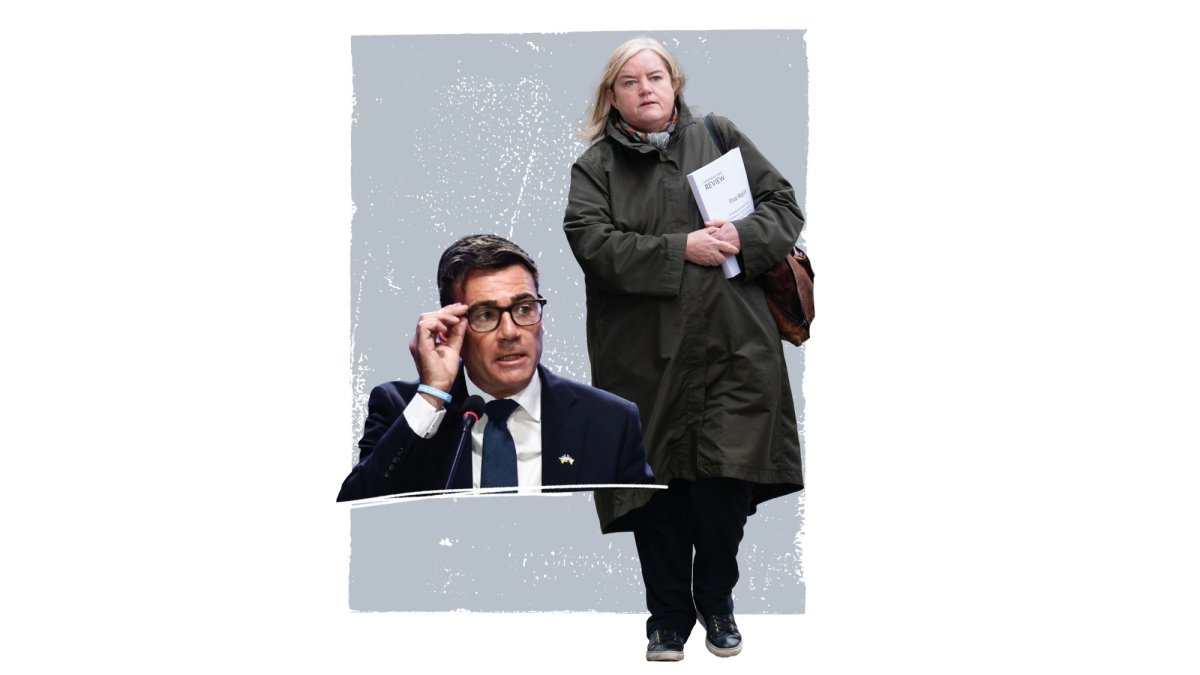
Andy Burnham, say friends, runs towards problems, not away from them. In making social care reform a priority, the new Prime Minister is certainly doing that – he is charging straight at one of the most intractable issues in British politics.
Four previous efforts at reform in the last two decades have foundered. Public understanding of the issue is limited, indeed even experts can’t agree which of the series of interlocking problems is the most urgent. Is the main problem the ruinous consequences for some of having to pay catastrophically high care costs, usually in later life? Or that the creaking sector is a potentially fatal drag on the NHS? What about the huge skill shortages? Or the ever-increasing costs of caring for working-age disabled people now living long lives thanks to improved medicine?
The only point of agreement so far is that cutting this Gordian knot is going to require a very expensive knife. With no appetite for additional taxation, and borrowing levels already nudging the UK into the sights of bond vigilantes, it takes a bold leader to decide that this is the moment for another crack at social care reform.
Wes Streeting didn’t think it was worth an early fight. As health secretary he announced a National Care Service but then set a 10-year timeframe on defining what that meant.
Burnham has picked up the structure of that effort led by Louise Casey but wants to turbocharge the process.
Baroness Casey’s Independent Commission on Adult Social Care will now report a year earlier.
A ‘national conversation’ that seeks to engage voters has been launched, while at Westminster Burnham has initiated a fresh set of cross-party talks.
“There is a massive public job to be done to explain just how ungenerous and how unfair the current system is,” Sebastian Rees, a principal research fellow at the Institute For Public Policy Research, tells The House.
Rees believes this was a key barrier to Theresa May’s ill-fated proposals in 2017, branded as a “dementia tax”, which she was later forced to abandon. While Rees argues that May’s reforms were “relatively generous and relatively well thought through”, they ended up collapsing after her party failed to make the case to the public that the current approach was “disproportionate and unfair”.
“But if people don’t believe that to be true, then advocating for reform is very, very tricky.”
This plays out in the figures. Research by Ipsos published last year revealed that nearly one-third of the public mistakenly believe the NHS provides the majority of social care services for older people, with a similar figure incorrectly believing that social care is free at the point of need.
Labour MP Anna Dixon, who has spent the majority of her career so far working on the issue, agrees that the conversation needs to be approached from a different direction this time around: “This touches on so many people, and that’s the point that we keep failing to get across – that this is not something over there that affects a few people. Caring one way or another impacts us all, either at some point in our lives needing care, or giving care.”
Dixon tells The House that she hopes the groundwork being done now to build cross-party consensus will protect any progress that is made from party politics.
“I hope there will be a Labour government to see this through. But just making sure that there’s enough groundwork being done, enough consensus built, that if there were any change in government, that the progress wouldn’t be reversed and halted or put off as we’ve seen has happened before.”
Two sets of cross-party talks had already taken place with Casey under the Starmer administration. Liberal Democrat spokesperson Helen Morgan tells The House that while they were “broadly helpful”, she is not convinced that they moved the conversation forward, describing them as a “general talking shop”.
The House understands that there will now be quarterly cross-party talks for both health teams and leaders separately. The former will next meet after Parliament returns from conference recess in October, and party leaders will do so the following month. It is understood that Casey will attend the talks with the shadow health team, while Burnham will join the Baroness for the leader talks.
As Conservative health spokesperson at the time, Stuart Andrew attended the first cross-party talks on behalf of leader of the opposition Kemi Badenoch. Speaking to The House before he was shuffled out of his shadow cabinet role, Andrew – who almost lost his seat in 2017 over May’s “dementia tax” proposals – thought that the dual approach being taken would encourage real reflection, allowing leaders to bring key discussion points they have considered with their health teams between the meetings, sharpening the focus.
While the talks are well-intentioned, there will be concerns that leaks and briefings could lead to them quickly breaking down. Andrew insisted the wish of the health teams was that any talks would not be leaked, allowing them to take place without fear that ideas would appear in the headlines the following day.
Andrew argued that “outlandish ideas” can sometimes breed a feasible and workable solution.
But without the confidence to be frank and open in these discussions, he did not believe parties would be able to “really get into the weeds”.
There is a massive public job to be done to explain just how ungenerous and how unfair the current system is
The shadow health secretary was positive about Casey’s ability to manage the talks and move the dial, praising the peer for visiting the constituencies of each health spokesperson to talk about social care in their area. Andrew believed first principles for reform would be discussed once Casey returned to the health teams with more information gathered.
He said Casey was working with a big team, including many individuals she has worked with for years. While the peer has been visiting constituencies, Andrew said her people had been going further afield as part of their work on the commission.
Working closely with government on the talks could be seen as a real opportunity for the Liberal Democrats. But The House understands that there is concern within the party that people don’t see raising taxes as translating into better outcomes. Working in coalition with other parties has not, of course, ended well for the Lib Dems in the past.
Speaking to The House, Morgan says the party is open-minded but makes clear there are red lines. “We wouldn’t sign up to anything that we thought would be damaging in the future,” she says, clarifying that this would apply both to the party and the country.
Morgan says the Lib Dems will be approaching the talks with three tests: reforming the carers’ allowance; a universal safety net, including free personal care; and protection from catastrophic costs, so that people aren’t faced with having to sell their house to meet their care needs.
When the cross-party talks were announced in July, Reform UK was not included, and while the party voiced anger at its exclusion from the talks, arguably such a move by Burnham could suit it well.
While former MP and Tory defector Anne Marie Morris was brought onto Reform’s shadow team to carry out a social care review, she has now left her role. It is unclear how much progress, if any, was made on the area. The role of health spokesperson has also taken a back seat after David Bull took up a role at Talk TV and was made party chairman.
A source close to Reform tells The House that the party would be reluctant to touch the policy area due to the NHS attack line – one of the few levelled at the party that has stuck.
Louis O’Geran, external affairs manager at More in Common, also points to Reform tensions over the economy, an area over which the party’s voter base is split. He argues that the party “has to straddle this really awkward coalition when it comes to the economy, which is why on questions like this you tend to get split right down the middle on issues of taxation”.
Taxation is also a matter of contention for the Tories and one they made clear from the start.
Rees believes that cross-party talks can only take the country so far on the road to reform.
“The biggest barrier is some sort of consensus on the funding model and the approach to funding is ultimately the thing that always brings down social care reform, and it probably calls into question trying to do this through cross-party consensus,” he says.
“My retort, whenever I hear, ‘You need different parties on board for this’, is if you’d taken that approach with the foundation of the NHS, we never would have had an NHS because at some point it requires some political bravery.”
Another sticking point for Burnham is how this all fits with his ambitions for devolution, Rees argues. While the conversation around public services has been very much geared towards moving decision making out of Westminster, the tide when it comes to social care seems to be moving the other way.
“Where we’re going with social care reform looks quite centralising: we think it should be a universal entitlement, we think everyone should be supported more, and there should be some national standards. And it will be difficult to tease out how you negotiate some of those tensions and trade-offs.”
In his first major speech as Prime Minister, Burnham said the failure of past governments to grasp social care reform had been a “major dereliction of public duty”, adding that it was “shameful that politicians have put point-scoring before fixing this issue”.
Time will tell whether Burnham becomes yet another prime minister whose efforts to reform the system are resigned to a footnote in the history books.